
Threshold Thursday: On Being Unsynthesizable Wild Card
The pressure to qualify for whatever comes next is its own kind of static. This piece is about the parts of you that were never going to qualify, and makes that the interesting development rather than the failure. Somewhere inside it is a mathematical concept, your least manageable instincts, your instincts to over-manage the least manageable instincts, and a theory about why the unplanned, wild card is the one that changes everything.
THRESHOLD THURSDAYNATURE & CYCLESSPIRITUAL MARKETPLACESHADOW & DARKNESSSOVEREIGNTY
The "good people split from bad people" version is worth naming for what it actually is: apocalyptic elect-narrative, analogous to every rapture philosophy that ever existed - we ascend, they get left behind. Wrapping that in "unity consciousness" language doesn't resolve the contradiction, but makes it harder to see.
"I am included in the saved group, which means my concept of unity conveniently stops at the border of people I've already decided are lost."
That's a very transactional approach that circles around who belongs to the winning camp and who doesn't, the vague feeling of fortune at having signed up for whichever side feels like it'll win the survival lottery - and that framing implies the whole work, the genuinely harsh, sometimes exhausting work of building bridges, of remaining available to people who might change if given space, or signing off on those who clearly don't want to, gets skipped entirely. Cruelty and putting dominance above everything else will stop being sustainable, and in this, the timeline split carries real truth in its most popular version. But it won't happen overnight, won't happen without people getting multiple chances to recognize what their reactive patterns cause, and then putting in effort that goes beyond desire for change. Desire opens a possibility that was closed. It doesn't walk through the door for you.
So discarding "good people split from bad people" would benefit you, because there's an actual phenomenon underneath the term 'timeline split,' and it operates nothing like the spiritual sorting ceremony it became.
Mathematics
In complex dynamical systems, there's a phenomenon called bifurcation - the mathematical description of how systems transition between qualitatively different states.
A system that has found its equilibrium - its attractor - returns to that state regardless of what you do to it, push against it and it comes back, disturb it and it settles. Then one parameter shifts beyond a threshold and that attractor becomes unstable, the system can no longer live in its previous state, and the single stable path splits into multiple possible trajectories, with which one the system falls into depending entirely on which perturbations hit it at the critical moment - the unplanned element, the variable nobody was tracking, the card nobody knew was in the deck. Systems approaching bifurcation become hypersensitive along the way - small inputs produce disproportionate outputs, what was negligible becomes decisive, what was absorbed starts propagating everywhere.
When that concept traveled into spiritual language, it arrived as sorting - good people ascend to Timeline A, bad people stay on Timeline B, see you never. The rapture with crystals. Bifurcation describes the system as a whole approaching a state transition, where the landing is determined by which perturbations operate at the critical moment, and who qualifies as spiritually advanced has nothing to do with it.
The timeline doesn't split people - the trajectory of the whole thing shifts. Everyone is inside the system, either functioning as a perturbation that nudges the direction of collapse-and-reorganization, or as background noise the transition happens around, and waiting to be sorted into the right timeline is, by the very mechanics of how this works, background noise - perturbation requires active input, and passive readiness, however refined, doesn't register.
So What Is Actually Splitting?
Humanity. The system is splitting away from the historical trajectory we followed for centuries if not millennia - a departure rapid enough, different enough, unrecognizable enough within a relatively short time span that calling it a point of no return almost fits. I wouldn't call it 'a point' though, because I don't experience it as a singular moment or day from which it begins. Still gradual, but a faster type of gradation than we're used to thinking of. My own speculation and inner sense.
The old attractor has destabilized. The system can no longer return to the pattern it maintained, and the transition period - this one, right now - is the chaos between attractors, between the collapse of the old stable state and the emergence of whatever comes next. You don't choose which branch the system takes by being a good person. You influence it by being a perturbation that matters at the right moment.
Which brings us to chaos and what it's actually doing.
And the popular concept of harmony needs a full autopsy.
Peace, stillness, elevated frequency, frictionless connection, universal acceptance - that version resembles the closest thing to a dead system that can still technically be called alive. Your body is harmonious because millions of processes run simultaneously in productive tension with each other, each one perturbing, each one being perturbed, arriving at a dynamic balance that looks stable from outside but is constant turbulence underneath - the turbulence is the health, how responsiveness to the world stays alive. A system that achieves prolonged, undifferentiated stability has either lost its plasticity or its metabolic processes have ceased - rigidity or death, and sometimes both wearing each other's clothes.
The environments described as chaotic - high friction, high conflict, high perturbation - these are where things actually get built, because what emerges from contact with genuine resistance carries something in it that nothing cultivated under controlled conditions ever develops. The instinct to stabilize and harmonize during genuine systemic bifurcation pulls toward premature closure, toward a stability that is simply no longer available. The attractor is gone, and the desire to return to it, understandable as it is, works against the transition.
Harmony as commonly desired, examined honestly, looks indistinguishable from stagnation. If everything is accepted, everything equal, nothing resisted, the signal guiding toward greater complexity goes silent. Complexity has never once grown in silence.
When you're inside something chaotic and brutally unclear, the real question is which perturbations you're introducing, and whether they're nudging the bifurcation toward something worth arriving at.
Managing Expectations, Or Rather, Demolishing Them
There are groups of people expecting this shift to remove from human experience all ideas of conflict, discord, predation, jealousy, shame, fear, distrust, pain, suffering, violence, vengeance, competition, feelings of being left alone with our problems - or even the concept of problems itself. Some of these will decrease in how commonly they occur and in the wide-spread post-effects they leave on our lives, though to a large extent that's also the matter of learning to self-regulate, of learning how to approach such events so their range of damage shrinks. They will be more commonly and unapologetically pointed out. They won't have a background of corruption and obscene money paid to keep people's mouths locked. But many of the ones I listed don't fall under that category, so don't let yourself be convinced that a timeline shift will arrive and free you from recurring shame, fear, helplessness - those still require working with them, likely in different ways than what we're seeing now, where strategies for burying unwanted emotions keep failing and reveal themselves as always having been mechanisms for temporary burial.
Even now, we need to cooperate with our feelings of every kind, making good friends with them so they become useful signals, useful pointers, useful signposts - decision-influencers more than decision-makers, and we'd be shocked to know how often at least a grain of what they signal carries information that's hard to get from anywhere else, even from anywhere else inside us.
The idea of conflict will likely increase, especially early, because we've been avoiding certain conflicts through people-pleasing and politeness-based approaches for so long - and how long can you fake your attitudes and reactions at this point? For me it became impossibly short within the last two years. The tension of faking a response, a reaction, my words, became unbearable very quickly.
Authentic anger, authentic jealousy, authentic disgust, authentic misunderstanding are all better than faked joy, faked communion, faked acceptance, faked understanding.
Authentic reactions cause conflicts, which is exactly why we avoided them. In some cases the fear of what we would really do or say is fear that wouldn't confirm itself, and in many cases it would, requiring us to learn how to approach conflicts, how to let people have their opinion about us and our reactions, and to discern whether the conflict is worth investment, whether the relationship itself warrants continued investment. In some cases it wouldn't, and there are things and people worth far more than what they currently receive from us - we're always lacking time or fatigued, so free energy becomes available the moment we stop dispersing it in every direction indiscriminately.
It Takes One to Know One
What this threshold requires - and this is where the "good people/bad people" split reveals how small its actual range is - is a kind of love entirely outside the romantic register. Love as acknowledgment of reality's right to be coherent on its own terms, everyone included, each person moving through their particular process at the pace that process actually needs, through whatever phases, using whatever mechanisms they found.
Because who genuinely has the authority to declare that pace too slow or those phases wrong?
The desire to rush other people's process tends to be a projection of how urgently we're rushing our own, or of how urgently we were rushed through phases that needed more time and got less.
Most of us push too hard through our own process. Spiritual bypassing, reality filtered through wishful thinking, the elect-narratives about who ascends and who gets left - these emerge partly from burning through introductory phases faster than the system can absorb, the spiritual equivalent of speed-reading a language you're still learning and then wondering why nothing holds when you try to speak it. I did this at a pace that eventually required me to stop and actually integrate - however slowly - while needing my life to keep moving. Because this work is also my livelihood, blind spots leaked into my early writing, patterns I hadn't yet sat with long enough to understand finding their way through, and even recent work isn't free of them. Becoming aware of your patterns opens doors that were closed before - you can't work with what you can't see - but the opening of the door doesn't change the room. It just registers that you react a certain way, that something from years back still has weight, that a grief never got properly handled.
Awareness of a potentially unhealthy pattern doesn't require you to change it.
When a pattern hurts others to sustain itself, yes, then action matters, and significantly. But that's not always the situation, nowhere near the most common one. The reflexive "recognize shadow, change it" equation skips the most important step - understanding what the shadow is actually doing there, what it's been holding, what would happen to the system if you removed it. Shadows are solutions to older problems that haven't been retired yet, and sometimes they remain solutions to current ones in ways you won't see until you've tracked how your patterns interact with the world around them - what they affect, what they protect, what they cost. Sometimes holding onto a pattern is what keeps a coherence alive that abandoning it would fracture. The work becomes ownership then, without judgment. What you already know about yourself and decide to hide from yourself doesn't stay hidden - it curdles into something much harder to work with than the original material was. Repressing a truth you're already aware of is how something becomes genuinely toxic, an attractor for exactly what you were trying to repel. You can't amputate parts of yourself into health. That lesson has a remarkable patience for being tested, and showing you that it will not ultimately work that way.
So carry your shadows with awareness, seriously, but don't let that awareness collapse into a demand that every shadow be transformed the moment it surfaces. The assumption that consciousness and light and awareness are categorically benevolent forces whose job is to colonize every dark corner they find - that one deserves some scrutiny. Too much of anything disrupts the diversity that keeps a living system alive and responsive, and spiritual overreach has a specific face - total illumination, having worked through everything, being all light. Living systems need their unlit rooms. They need drives that haven't been refined yet or given a spiritual justification for their existence. Raw material waiting for a direction worth moving toward.
A hunger that doesn't find its food doesn't disappear - it finds worse food. The shadow that routes around you and finds expression through the cracks is doing its job with unusual precision, solving the original need with whatever it can reach. Distortion strips the packaging away and tends to be remarkably honest about what was actually missing. A rage surfacing as passive aggression is still a rage with something genuine underneath it. A possessiveness that becomes control is still a hunger for safety that never found a direction it could trust. The worse food is ugly. It's also honest about what was starving and for how long.
This is where ownership does something condemnation can't. When you can see the original need underneath the behavior - what the shadow was actually solving, how long it's been solving it, what it would cost the system to simply remove it - you can give the hunger its actual direction. The drive that was routing through every available crack because you refused to open a door now has a door. Same hunger, entirely different territory it moves through. A shadow that's been finding worse food for years will move toward the better offer with a speed that tends to catch people off guard. The hunger itself has always been the energy. It just needed somewhere worth going.
You Are The Perturbation
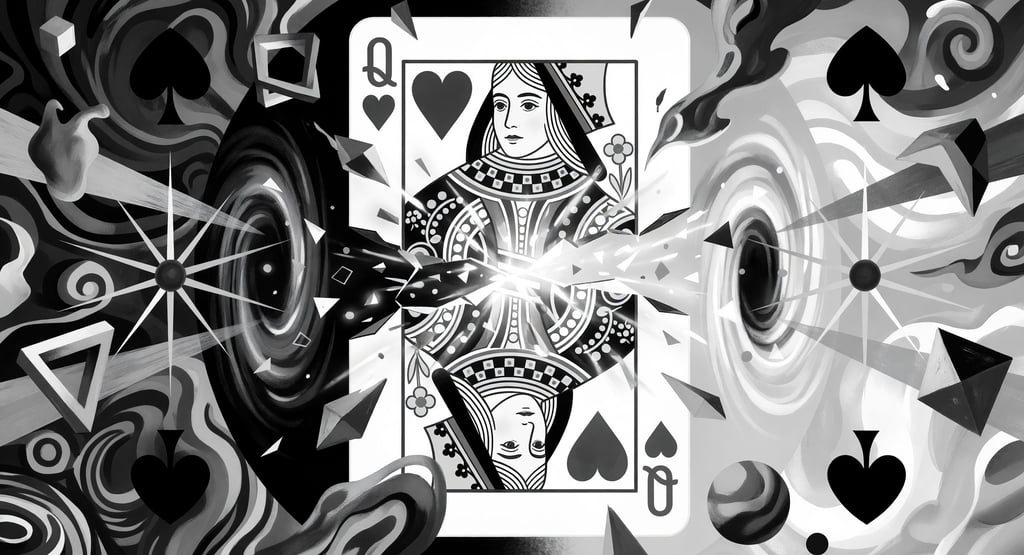
Your authentic reaction, what you actually think, the way you actually are - the unmanaged self with opinions and edges and instincts and unpredictable responses that you've been shaping toward palatability for as long as you can remember - that's the perturbation, the card the system didn't know was in the deck and can't synthesize now that it's been played.
A system absorbs what it already modeled, and everything curated to fit was shaped for the system's digestion, made safe, unable to move anything. The people functioning as genuine bifurcation-influencing perturbations are the most irreducibly themselves, the ones the system can't predict, absorb, or neutralize, and this includes people we'd rather not give credit to, which complicates the elect-narrative considerably.
As for those already working to trigger change on their own scale - wanting change isn't enough, and staying with your own change isolated from being a role model for others who are hesitating, or haven't even considered whether change is what they want, that's where the perturbation actually reaches the system. It requires being inside it, with both feet in material reality.
Activities you love to come back to.
Self-regulation infrastructure that lets you log off completely from constant output.
Things that make you relax, laugh, share joy with your people.
Actually enjoying a vast part of human experience, which requires certain wealth accumulated, expenses covered, self-sufficiency achieved - because self-sufficiency demands larger degrees of freedom to be genuinely independent.
Unsynthesizable Wild Card Between Worlds
Systems resist perturbation by definition - that's what makes them systems. You won't be absorbed smoothly - you'll create friction, make people feel things they were managing not to feel, introduce asymmetries into equilibria that held because everyone agreed to leave them undisturbed.
The edges, the instincts, the irreducible ways you are - all of it needs somewhere to go. Aimed at genuine direction it becomes perturbation toward complexity, and aimed at feeding your own hunger for dominance it becomes noise toward collapse. Developing the capacity to direct these drives rather than be driven by them is where the entire thing pivots.
A perturbation is only as effective as its source's capacity to remain coherent and present - grounded enough to absorb friction without being absorbed by it. Perturbators who are financially desperate become compliant fast. Perturbators who are socially isolated become strange in ways that stop being useful.
The system is bifurcating, and where it lands depends on the perturbations operating at the critical point. Every layer of curated selfhood presented instead of the actual self pulls one step further from that capacity. The world has more than enough qualification. It needs perturbation.
And perturbation, at its most effective, looks a lot less like ascending and a lot more like staying right here, thoroughly yourself, refusing to dissolve into whatever the field is already doing.
Autopsy of Harmony
Before a system bifurcates, it gets louder, more volatile, increasingly sensitive to anything touching it, old stable patterns breaking down long before new ones form, and from inside it looks like everything failing simultaneously and nothing meaning what it used to. The common narration frames this as purification, frequency test, sign that ascension is in progress - and it captures something emotionally real about the experience. What the bifurcation frame captures is something mechanically real - the system becoming chaotic before a state transition is simply how state transitions work. The chaos is the mechanism, not the obstacle.