Psyche Attack - Part Two: The Foreign Author
Two well-funded empires have built entire industries on the same blind spot. One calls it a brain event. The other calls it an invasion. Both hand you a solution and quietly require that you stay passive long enough to need it. This is about what actually got in - and why the mind would rather invent a demon than sit with the thing the demon is covering.
PSYCHE ATTACKSPIRITUAL MARKETPLACESHADOW & DARKNESSSOVEREIGNTY
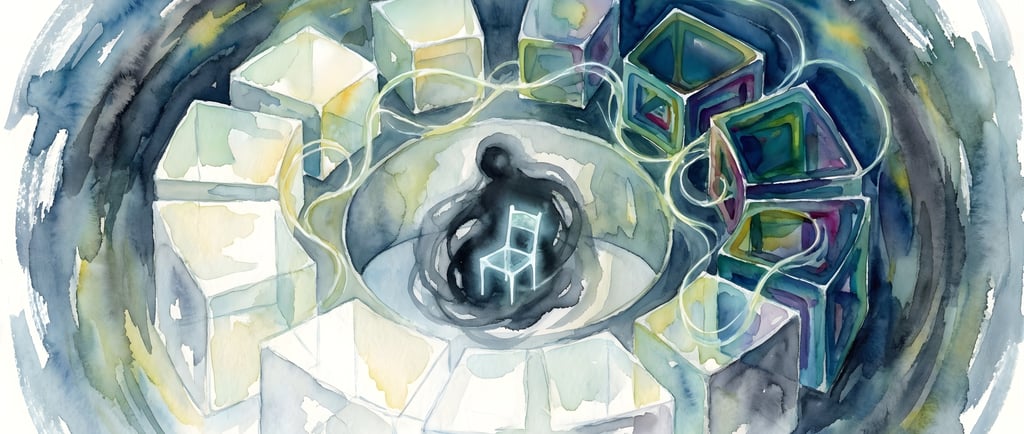

The word psychic comes from psyché - Greek for soul, for animating breath, for the living principle that distinguishes a body from furniture.
At that root, a psychic attack is the psyché turning against its own tissue because it lost its central reference point.
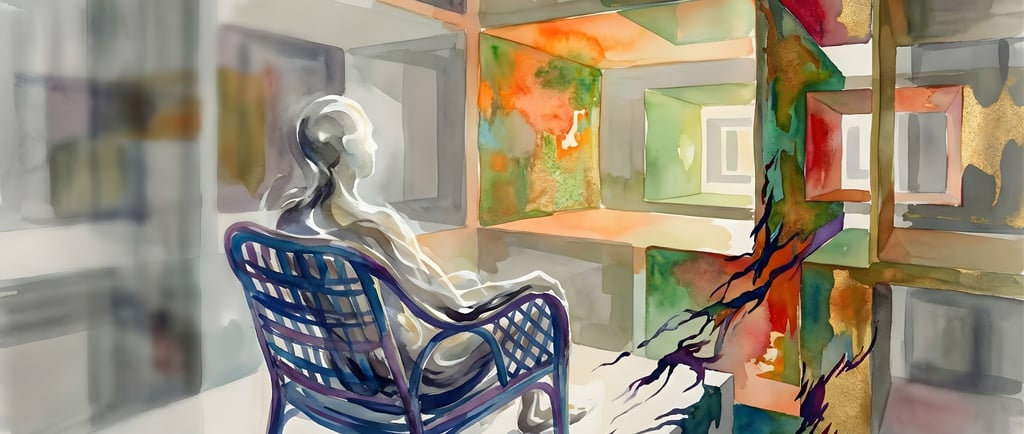
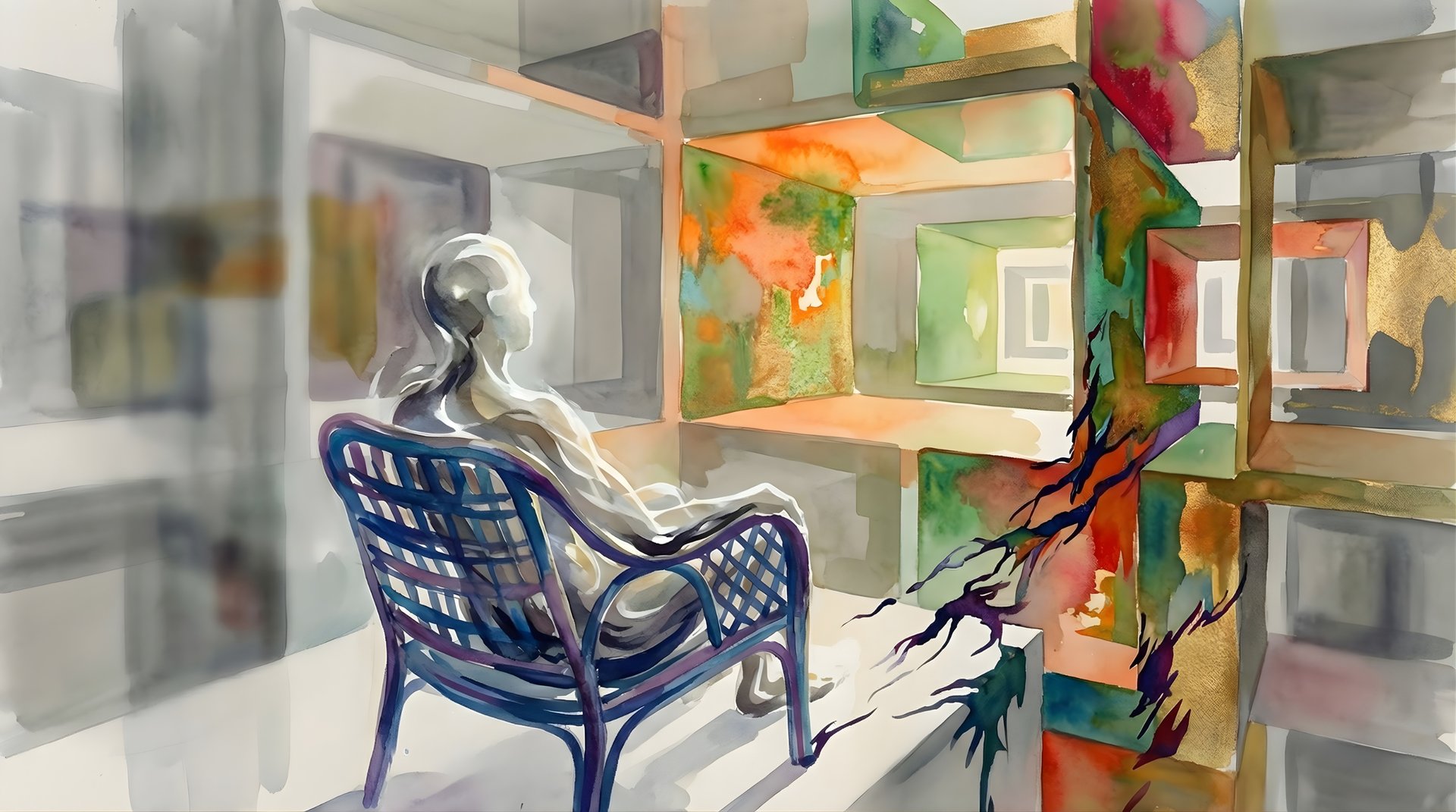
The attack, projected outward as a curse or internalized as a structural malfunction, functions as the psyche generating noise to fill a vacancy - anything to account for why the seat feels empty and the house feels haunted. Anything to explain why experience no longer feels authored from within.
The mind would rather be invaded than abandoned.
We built two entirely separate empires to avoid looking at the empty seat.
In the psychiatric empire, a mind turning against itself represents a biochemical glitch requiring pharmaceutical management.
The psychiatric community will tell you something broke down. Neurochemistry went sideways, genetics loaded the gun, trauma dysregulated the wiring. The solution is some variation of intervention - medication, therapy, someone with credentials who knows what they're doing. You, meanwhile, wait.
In the spiritual empire, the exact same phenomenon represents an energetic invasion requiring ritual warfare.
The spiritual community will tell you something got in. An entity, a cord, a curse, some energetic contamination from your jealous ex or the stranger who looked at you funny. The solution is always some variation of protection - a ritual, a practitioner, someone sufficiently initiated who knows what they're doing. You, again, wait.
And yes, both systems contain useful tools. That is what makes the blind spot harder to see. Something can help you and still misunderstand you.
A very marketable way to avoid the real question
A "psychotic episode" gets framed as something internal. A brain problem. A system glitch. A chemistry issue. A damaged regulatory loop.
A "psychic attack" gets framed as something external. Something entered your field. Something attached. Something found a crack and moved in.
Both empires require you to be a passive recipient of external damage - either bad genetics or bad spirits.
Psychiatry genuinely cannot bill for "lost contact with Spirit” and the healer needs something to clear. One sells management. The other sells cleansing. One gives you a diagnostic code, the other a ritual bath. Different costumes, same basic move: the source of the problem gets placed somewhere that just so happens to justify the preferred intervention. Everybody gets to feel useful. Meanwhile the real question keeps sitting there, uninvited and unimpressed;
Who is living your life from the inside?
The haunting is real.
The contamination model of spiritual harm carries a dangerous, partial truth;
Something did get in.
Usually not a demon.
Usually a verdict.
Someone else's authority entered early and stayed late. Someone told you what you are. What you're allowed to feel. What counts as real. What should be denied. What makes you lovable. What makes you broken.
Repeat that long enough and the external judge gets internalized. In my case; the gaslighter leaves the physical room - the gaslighting continues, staffed entirely from within.
That is how a person starts feeling watched from the inside.
The haunting is real. The ghost is often a colonized pattern.
The Witness buried under someone else's version of you generates that signature. You can burn sage until the air is unbreathable and it doesn't touch this. So when people say they feel invaded, influenced, psychically dirty, full of thoughts that don't feel like theirs - there is often a real phenomenon underneath the dramatic language.
Not supernatural contamination in the cheap sense - structural contamination.
Internalized command. Foreign authorship wearing your voice.
Why the mind invents an intruder
Neuroscience has a colder way of saying some of this, and in this case the colder language helps; the brain works as a prediction engine. It is constantly trying to explain incoming sensations, emotions, impulses, and thoughts. It does not enjoy loose ends. It wants source labels. It wants a story that makes the math close.
So what happens when an experience shows up with no felt author?
What happens when a thought appears, but it does not carry the inner signature of "mine"?
Simple.
An unauthored thought is a problem. A fear with no owner is a problem. A surge of emotion that feels detached from the core self is a problem. And when the system cannot locate the author, it often manufactures one.
The alternative - sitting with the vacancy directly - is unbearable in a way that even genuine suffering isn't. Genuine suffering has an object. Vacancy doesn't.
So the mind invents one. It hallucinates an external origin for material that lost its authorial tag when the central self evacuated. The content it picks depends entirely on what the surrounding culture has made available. Demons where demons are plausible. Persecutors where paranoia is the dominant narrative. Psychiatric symptoms where that's the framework being handed out.
The brain fills the gap with whatever explanation fits the local vocabulary.
This is not stupidity. That's just how trying to keep reality coherent looks like. That is why external-attribution experiences can feel so convincing. They solve an unbearable equation.
Better an enemy than a void.
Better an invader than the suspicion that nobody is home.
But relief is not the same thing as restoration.
What sovereignty requires
Spirit-level sovereignty (as well as protection) requires the brutal re-occupation of the Witness seat. It requires the return of jurisdiction, the act of becoming again the sole author of your own experience.
The body matters,
trauma matters,
biology matters.
Terrible things happen to nervous systems,
brains can become disordered,
perception can fragment.
Medication can help,
therapy can help,
so can sleep, food, stabilization, and not taking metaphysical advice from people who mistake intensity for wisdom.
That part should not need saying, but here we are...
What also matters is that no intervention, clinical or spiritual, can substitute for the return of the inner witness.
Processing is not the same as jurisdiction.
You can calm the body and still not feel like the author of your own experience. You can do a hundred clearings and still be governed by foreign scripts. You can gain insight and still not be seated.
And until that seat is occupied, the psyche remains vulnerable to manufacturing noise. It will produce symbolic weather, inner persecution, strange loops, self-accusations, haunting atmospheres. Not because it is evil. Because it is trying to explain a vacancy.
The ugly work
Re-establishing sovereignty requires autopoiesis, which sounds academic until you understand what it actually describes.
Autopoiesis defines the fundamental behavior of living systems. A biological cell maintains its membrane not by being protected from the outside but by continuously regenerating that membrane from its own internal processes. The boundary is a metabolic byproduct. Remove the internal activity and the membrane doesn't just weaken - it dissolves, because it was never a structure in itself. It was the evidence that something was alive inside.
Real spiritual sovereignty works the same way.
A person becomes harder to invade - psychologically, symbolically, relationally - not because they stack up more shields, but because they occupy themselves more fully.
Boundary is the side effect of presence.
The practice, when you actually do it, is ugly. It does not sell as well as protection rituals with dramatic names. It feels worse at first, not better. Because reclaiming your interior means you stop outsourcing the chaos to monsters and start witnessing it directly.
You sit in the chaos of your own psychic fibrillation.
You look at the alien, terrifying thought crossing your awareness and you recognize it as an orphaned piece of your own architecture.
You let the strange image, the intrusive fragment, the psychic static show itself without immediately kneeling before it.
You watch.
You stay.
You do not abandon the room just because the room is ugly.
You tolerate being in a house whose wiring is throwing sparks, without calling in an exorcist or a psychiatrist, which is genuinely the hardest thing a person can do because both phones are right there and both calls feel responsible.
That is how authorship starts returning - not through performance, but through sustained non-abdication. Valid protection produces total independence.
The autopoietic soul requires no shields. It simply beats.
The body is where the return happens
The heart is not just a sentimental symbol. It is an electrical and electromagnetic center with measurable influence on the rest of the system. Its rhythms affect the brain. Its state affects perception. Coherence is not a poetic concept alone - it has embodied correlates.
So when people speak about "coming back into the heart" the phrase only becomes useless when it gets turned into decorative spirituality. In lived terms, it means inhabiting the body deeply enough that the system stops defaulting to dissociation, projection, and psychic outsourcing.
Not romance. Not vibes. Occupation.
The body is where the return happens or it does not happen at all.
You do not reclaim authorship by thinking prettier thoughts.
You reclaim it by remaining present enough to re-tag what appears in consciousness as part of your own field, your own history, your own unfinished architecture.
Not all of it is chosen.
Not all of it is flattering.
All of it still asks for witness.
Part 3 - how the seat is reclaimed
The house is still yours, but ownership and occupation are not the same thing. Naming the vacancy is only the second threshold. The next post turns toward method - how authorship returns, how the Witness reseats itself in the body, and what real protection looks like when it is no longer built from fear, dependency, or ritualized avoidance.