
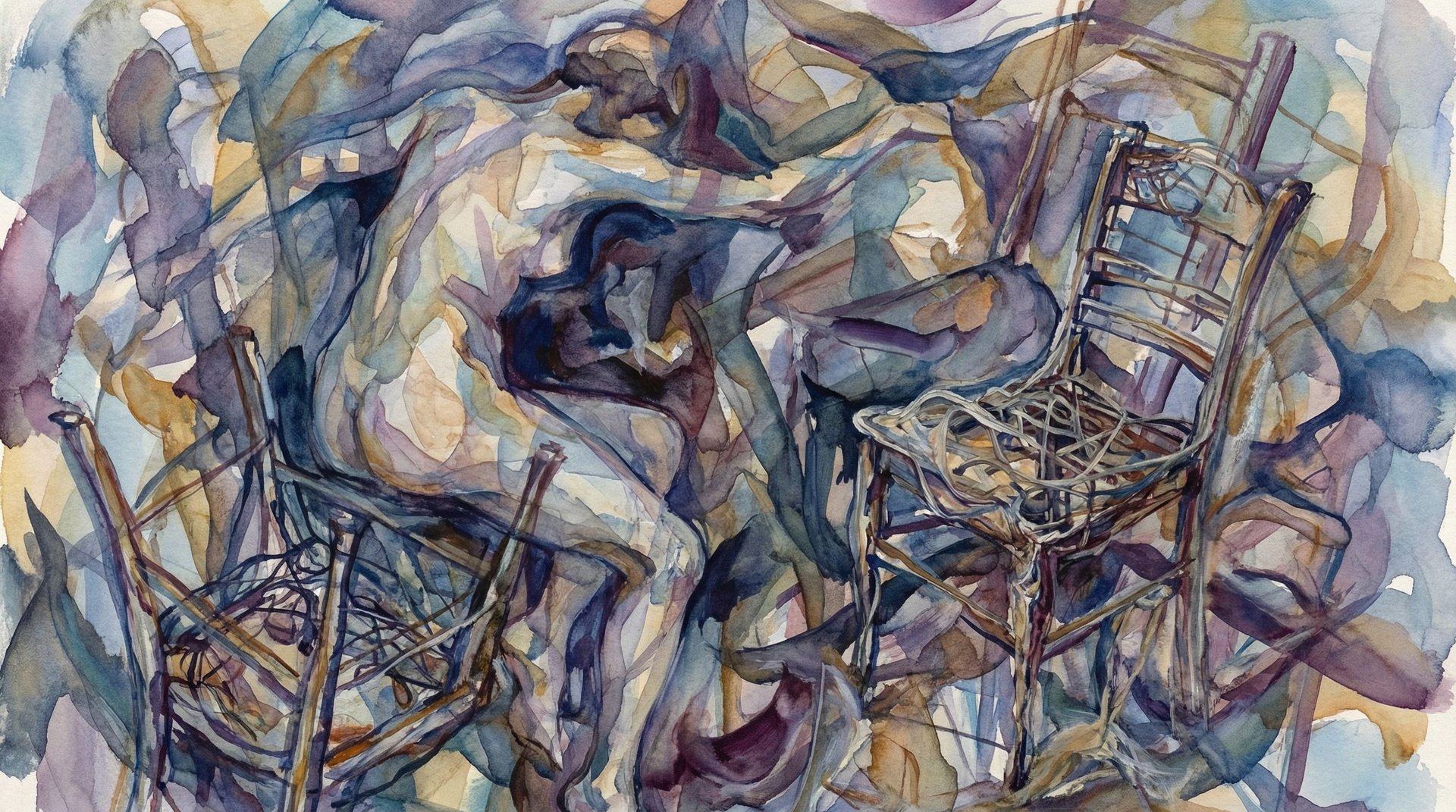
Psyche Attack - Part One: The Empty House
Most people ask what entered. Fewer ask what left first, and why, and whether it knew it was leaving. Psyche Attack is a series that starts at that prior question - the one underneath the crisis, the breakdown, the diagnosis, the spiritual emergency. Part One is not about what attacks. It is about what vacates. Because an empty house is not a neutral condition. It is an invitation written in absence, and something will always answer it.
PSYCHE ATTACKSOVEREIGNTYSHADOW & DARKNESS

Is This Real or Am I Paranoid?
Is this reality I'm living in? Or is it something else entirely?
There's a medical condition where the immune system forgets what belongs to the body. It turns against its own tissue - not from malfunction exactly, but from a kind of tragic loyalty to its purpose. The immune system was built to detect foreign signatures, to mark them as invaders and threats. But in this condition, it becomes miscalibrated, attuned to attacking its own biological signature.
I touched on this concept in my last channeling session: how we can do the same psychologically. In Celf-Defense I wrote:
"Energetic autoimmunity manifests as constant self-correction: monitoring every thought, policing every feeling, questioning every impulse."
This doesn't occur randomly - it must be trained.
When you've been taught, by someone, or by enough accumulated evidence, that your perception is unreliable, your mind becomes a security system that never stops scanning, with you as its primary target. What belongs to the self gets misidentified as a threat.
In both cases, the result is an exhausting, endless, self-consuming war against oneself.
Living in a mind you no longer trust is one hell of an experience.
Old interactions replay on a loop. A mandatory hesitation precedes simple answers. Every perception gets compulsively interrogated before it fully forms. Your mental processor maxes out. Nothing remains for presence, real contact, rest, or the kind of thinking that actually builds something new.
Claiming you are doing it to yourself seems harsh but don’t you?
You spend your days searching your own interior for breaches. Thoughts carry the texture of invasion. Intuition and projection start wearing each other's clothes. Meaning gets outsourced -to louder voices, stronger personalities, diagnostic systems, spiritual explanations, or pure fear.
All available energy is consumed by the effort of not trusting yourself. Anything outside the self feels more reliable than what moves through it.
And I know this territory from the inside.
I know the taste of having your reality bent through manipulated perception. I could now begin with the gut-wrenching, soul-crushing description of my deteriorating sense of reality, well
It sucked.
After being gaslit by someone I loved, doubt stopped being a momentary experience and became a structural feature of my consciousness. It didn't just shake me, it turned my impressions into verdicts against my own reliability. I began to doubt my very doubts. This sense of unreliability seemed to grow organically, spreading like a psychological mold.
The psychotic break that followed made self-distrust feel like the only reasonable response. It felt empirically grounded, rational.
People like to imagine that confidence protects against this. As if collapse belongs mostly to the timid. As if the fragile go under first, while the bold remain intact.
You'd think that's what breaks people - lack of spine, lack of faith in oneself. That those ones are easier to coerce, easier to bend, more prone to compliance, to that prey-animal consciousness where survival means making yourself small.
I see myself as a rather confident person, bold even, though not always, not consistently, and many times it's my anxious side that shines brightly. And I let it. In the end, it wasn't shyness that caused my inability to tell what was and wasn't real. A highly confident person can be driven mad just as efficiently as an insecure one.
Confidence is useful in the social world. It helps with pressure, presentation, friction, territory. It can help a person hold eye contact, hold a boundary, hold a room. It cannot restore the ground of perception once that ground has been destabilized.
When you say, "This happened, I was there, it felt like this," you are not drawing from confidence. You are not summoning bravery. You are doing something more basic.
You are witnessing.
There is a function in the psyche that can register thought, sensation, emotion, memory, and image without becoming identical to any of them. Some traditions call it the Witness. I didn’t want to mess with such an establish framework and land on “authorial position”
Not personality. Not performance. Not self-esteem.
The place in you that knows an experience is yours while it is happening.
Why does this distinction matter? Personality can be shaped by fear. Performance can be trained. Self-esteem can rise and fall with circumstance. The authorial position runs deeper. It is the seat from which experience is received, sorted, and claimed.
When that seat is intact, things can be processed. Signal can be distinguished from noise. Intuition can be separated from projection. Pain can remain pain without becoming total reality. Contact stays possible without total merger.
When that seat weakens, self-trust does not merely drop. The organizing axis of experience begins to wobble.
You stand absolutely certain of nothing.
When your direct perception is less trustworthy than somebody else's interpretation, being present starts to feel dangerous. Absence starts to feel smarter than inhabiting a self that keeps getting overridden.
So the author leaves.
Quietly.
Without ceremony.
The way people leave places they once loved.
Then the empty seat fills.
It fills with internalized criticism, foreign verdicts, old fear, unfinished grief, inherited narratives, ambient tension, borrowed cosmologies, intrusive thoughts, unnamed threat.
The house is still standing.
But the author is no longer home.
“You are not broken” - a reassurance appended to every mention of disordered behavior or unhealthy pattern a person can display, repeated more like a disclaimer. As though we need legal cover before naming what’s real.
Personally I find it lacking honesty.
You are not broken. Maybe. Don’t you feel broken anyway?
Something broke - in the continuity of trust, in the relationship between perception and authority, in the felt sense that one’s own mind is inhabitable.
Naming that does not create weakness. It restores precision.
Because something BREAK IN
Some people call it psychic attack. Some call it trauma dysregulation. Some call it thought insertion, spiritual emergency, fragmentation, collapse, sensitivity, contamination. The vocabularies differ (sometimes sharply, and the communities that carry them rarely speak to each other).
The lived structure often does not: Burglary.
Something entered the space the self vacated.
The central injury here is not low confidence. It is loss of the authorial position.
A biological analogy helps.
The sinoatrial node acts as the heart's pacemaker. It generates the electrical impulse that organizes cardiac rhythm. When that central rhythm breaks down, the heart does not simply stop. Activity continues, but coordination is lost. The muscle still moves, only no longer as a whole. Firing becomes scattered. The heart enters fibrillation: chaotic, uncoordinated quivering instead of a pulse.
Something similar happens in the psyche.
When the authorial center weakens, surrounding material starts firing on its own. Unanchored fragments of the subconscious, repressed fears, memory, fantasy, old voices, social residue, bodily alarm, external suggestion, unfinished emotion. The system is still active. Sometimes hyperactive. But activity is not the same as coherence.
That is why these states can feel crowded, charged, uncanny, or hostile. It is not always because something supernatural has entered the room. The result feels chaotic because it is chaotic. Because the system is trying to generate coherence in the absence of the thing that was generating it.
Spirit functions as the sinoatrial node of your reality.
The originating signal. The irreducible impulse of I.
The subtle but central pattern that allows experience to gather around a living axis instead of scattering into fragments.
The authorial position is the psychic seat that can receive that signal.
Spirit is not the seat itself. Spirit is the current. The authorial position is the place in the system that can conduct it.
When the connection weakens, Spirit has not vanished. The house has not become metaphysically abandoned. The signal is still there. It is simply no longer the loudest thing in the room. When that pacemaker goes quiet, everything else gets loud.
Fear imitates intuition.
Suggestion imitates revelation.
Intrusion imitates meaning.
And the person caught in it can spend years trying to determine whether they are under attack, losing their mind, awakening, regressing, or simply becoming more sensitive to what was always there.
Sometimes more than one of those is true.
But beneath all the language, one condition keeps appearing:
The center did not hold.
What Comes Next
The simple, essential fact: your interior life cannot remain open territory for every fear, imprint, suggestion, or invading voice that wants to occupy it.
Absence is prone to developing its own atmosphere, and people begin mistaking that atmosphere for identity.
The central injury here is a collapse of self-sovereignty at the level of perception itself.